

Insurable Business Risks:
What Changed in the Market Last Year
The past year marked a critical turning point for the insurable risk market. Not because entirely new risks emerged—but because the way risks impact business viability fundamentally changed.
Companies are no longer exposed to isolated incidents. They are facing interconnected risk chains that materialize simultaneously and produce immediate financial and strategic consequences.
From “Loss Events” to “Business Viability Risk”
For decades, insurance was designed around clearly defined loss events: a fire, a flood, a liability claim, or a temporary business interruption. The underlying assumption was simple—once the loss was indemnified, the business would resume operations and return to normal.
Over the past year, that assumption proved increasingly fragile. What became evident across markets and industries is that the most critical risk is no longer the loss itself, but whether a business can continue operating after the loss occurs. In many cases, the financial damage was only one dimension of the problem. Operational paralysis, reputational erosion, regulatory scrutiny, and stakeholder loss often followed in rapid succession.
This shift was driven by a noticeable increase in losses triggered by interconnected risk chains. Cyber incidents, for example, rarely remained confined to IT systems; they escalated into operational shutdowns, contractual breaches, and reputational damage. At the same time, many organizations discovered that their insurance programs were not insufficient due to missing products, but because of flawed risk design—coverage that existed on paper but failed to respond effectively to real-world scenarios.
Why Insurable Risks Became More Expensive — and Why This Was Inevitable
Over the same period, the insurance market tightened considerably. Organizations encountered stricter underwriting requirements, premium increases in critical lines such as Cyber, D&O, and Environmental Liability, as well as higher deductibles and narrower policy terms.
These changes were often perceived as aggressive market behavior. In reality, they reflected a deeper structural shift. Insurers are no longer pricing risk in isolation. Increasingly, they are pricing the absence of risk management.
Where organizations were unable to demonstrate structured risk identification, clear prioritization, and decision-level oversight, insurers responded predictably—by increasing pricing, reducing capacity, or imposing restrictive terms. Conversely, where risk was clearly understood and actively managed, underwriting outcomes were materially different.
The Risk Areas That Defined the Year
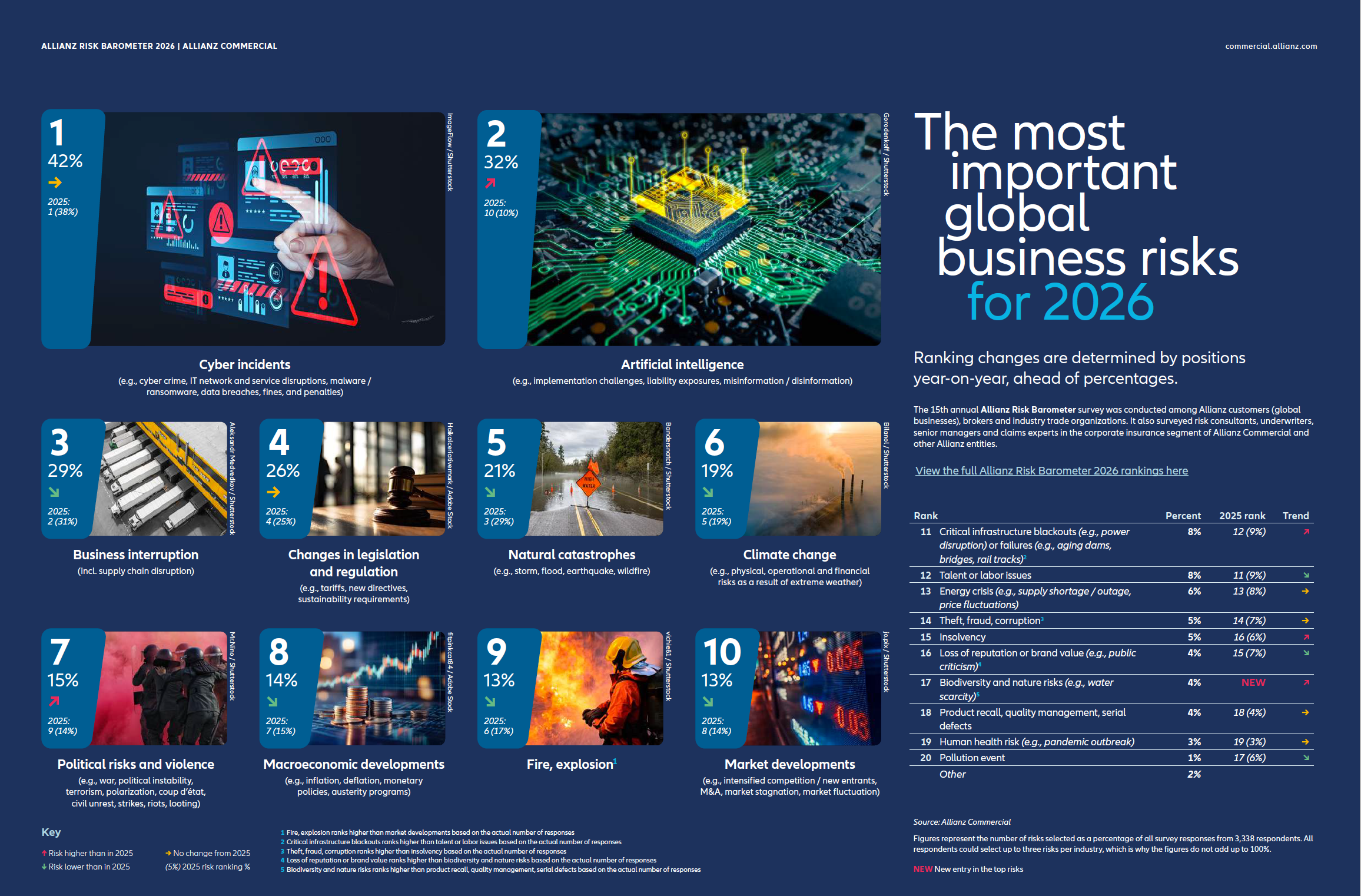
Global risk analyses consistently highlighted a small number of risk categories as dominant throughout the year. Cyber risk remained at the forefront, not merely due to data breaches, but because of prolonged operational disruption and regulatory exposure. Directors’ and Officers’ liability followed closely, reflecting the growing personal exposure of executives and board members in an environment of heightened accountability. Regulatory and ESG-related risks also rose sharply, driven by sanctions, restricted access to financing, and reputational consequences.
What connected these seemingly different risk areas was not their technical nature, but a common organizational weakness: the absence of documented, decision-level risk assessment. Where risks were not formally identified, evaluated, and escalated to leadership, insurance coverage alone proved insufficient.
Why Many Businesses Pay Premiums Without Gaining Real Protection
One of the clearest lessons of the past year is that ineffective insurance outcomes are rarely the result of missing products in the market. More often, they stem from fragmented decision-making, lack of prioritization, and misalignment between insurance programs and strategic objectives.
In such environments, insurance portfolios tend to evolve reactively. Low-impact risks are frequently over-insured, while exposures that directly threaten business continuity remain underinsured or poorly structured. The result is a false sense of security—significant premium spend without corresponding protection when it matters most.
From Buying Policies to Managing Risk
The market has made one reality unmistakably clear: insurance, in the absence of structured risk management, is not a protection strategy.
Organizations that demonstrated resilience over the past year followed a fundamentally different approach. They identified insurable risks systematically, quantified potential financial impact, and prioritized exposures based on their strategic significance. Only the non-tolerable portion of risk was transferred to insurance, while the rest was addressed through operational, contractual, or governance measures.
This approach delivered tangible results—lower total cost of risk, improved coverage quality, and measurable protection of liquidity and business continuity.
Conclusion
The past year did not merely reshape the insurance market. It exposed the difference between organizations that are genuinely risk-prepared and those that remain structurally risk-exposed.
In today’s environment, insurance is not an expense to be minimized. It is a risk-financing instrument—effective only when embedded within a disciplined, enterprise-level risk management framework.


